Dominic Rohner – Swiss XC Rider in Costa Rica (II)
Dominic Rohner is an instructor, guide, and member of the Swiss Paragliding Cross-Country League team. Last October, he broke his personal record of 538km in Brazil. Dominic recently visited Costa Rica and completed over 330km of cross-country flying in just four flights in the Rivas, Dominical, and Santa Elena areas of Guanacaste.
We have a very long interview (to be published in 3 chapters) in which he shares some tips for covering more than 500km in a paraglider, his experience and motivation in flight, his impressions of the conditions in Costa Rica for cross-country paragliding. And of course, a detailed explanation of his 90km cross-country flight in Guanacaste.
You've traveled the world extensively with a paraglider, often solo. Do you consider yourself a "solo" pilot, or do you prefer flying in a team? How was your last trip to Brazil?
No, no, I really wanted to go to Brazil with the whole Swiss team, but they all canceled because of COVID, and I had to go alone. But I prefer flying with people, with good people.
Four years ago, we started the Swiss Cross-Country Team. Although this was my first year, I wanted to try to break a record in Brazil. Flying as a team is more efficient, faster, and safer.
It seems that lately Brazil has become a "must-have" for Swiss pilots and world record holders. Just a few months ago, Yael Margelish became the first woman to fly 500 km, and she's Swiss, just like you.
Yes, Yael is a very talented and ambitious pilot, and she could soon break a new record. That would be significant, wouldn't it? A woman could hold a world record ahead of men, and she's capable of it, absolutely!.
What were the conditions like on the day you broke your own personal record?
The takeoff wasn't super early; I took off around 7:00 a.m. Sometimes it's possible to take off half an hour earlier, but that day the most important thing was that the wind was constant and strong at all altitudes. Well, it wasn't excessively strong either, and that's why I was never worried about having to land. That's already very good, psychologically speaking. Well, I had another "little problem": the landing was almost 45 minutes too early at 5:17 p.m. Sometimes it happens like that; a line dies out, there's no more thermal, and you feel like "I'm screwed"—either you've lost it, or it's definitely gone. That day it died out; my line died out.
This can sometimes happen. I lost about forty minutes of very valuable daylight.
Did you fly with other pilots?
I flew with other pilots; I wasn't flying alone that day. Pal Takats was flying in Assú that same day, and some other pilots who also went very far away.
Was a route planned beforehand?
The route? Well, we don't have to plan it like we did at the beginning, we've done it so many times, we just adjust it a little in flight.
Was it very windy that day? What was the most difficult part of the day?
Of course, there was wind, at all altitudes… Finally, after about 450 kilometers, I found a “wall,” a high plateau that crossed the line I was flying. There were about 50 kilometers there with very little place to land. And the thermals weakened, which was a little psychologically stressful. Since the wind was too strong to turn back, my only option was to climb on weak thermals and let the wind carry me. But it was about 40 or 50 kilometers with no real landings, just jungle—well, it's a very dry forest, but there are hardly any roads; a car can barely get through, or it simply can't. And wow, it was a bit stressful, not technically, but psychologically it was a little difficult.
Are you comfortable flying for 7 hours?
Yes, I feel very comfortable flying 7 hours in Caicó. The longest flight we've had has been 11.5 or 11.15 hours. I feel very comfortable with my team.
What equipment do you normally use for flying? Glider, harness, electronics…
In competition, in Caicó (Brazil), and if I do very ambitious XC, I use an ENZO 3. Before, I had the GIN Genie Race 4. It's very good, but it weighs a ton, so I switched to an Advance Impress 4, which is just as comfortable and aerodynamic but weighs much less and doesn't take up as much space; it's much easier to carry. That's important when you're in northeastern Brazil in 40-degree heat and you have to walk for an hour. It makes life much easier.
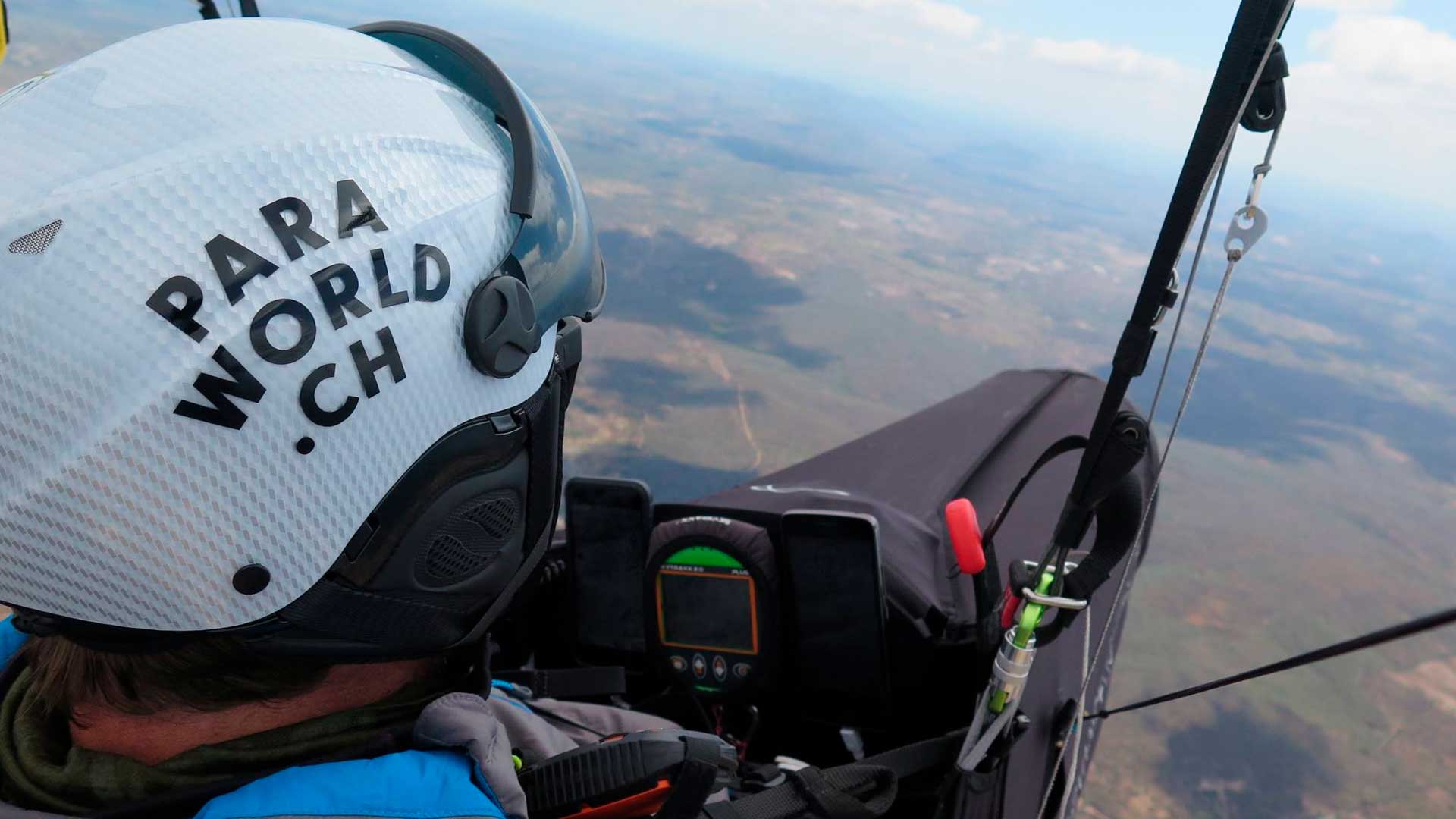
For the electronics, I'm using the Fly Master Live; I think it's very good. I like the sound of the Vario. Since Livetracking is also integrated, everything works well for me.
Although I use XC Track the most. I have both Flymaster Live and XC Track to visualize the terrain; airspace is very important in Switzerland, and even though XC Track only works on Android, it's still very useful to me. It's the same people who develop XC Contest, but they also develop XC Track, so it's well synchronized, which I love. The best thing about XC Track is that it's free. Well, some money is donated voluntarily so the development team can continue updating the app, and that's fantastic. I love it.
Right now I'm flying the Zeno. I know that in the XC Contest, they show an Enzo 3 in the tracks, but that's not the case. My Zeno is four years old, with countless hours on it, but it still flies well. The original model has been on the market for four or five years, but it's still a benchmark: it flies well and is somewhat easier to fly than the Enzo. Now I use the Advance Lightness 2 harness because it's lightweight and has a very small footprint. When I'm traveling, it's better that way—small and lightweight.
Last October, Rafael Saladini flew 555 km and broke the world record for a predetermined goal in Brazil, setting a new record of a solid 530 km in the Tácima region. What do we need to achieve that coveted 600 km?
We have nothing left, no more daylight hours, no better equipment, just the perfect day. We're not far off; the Brazilians have already reached 581, the straight-line distance from point A to point B. There's a difference of 20 kilometers, nothing much, basically just a thermal, a good one at the end of the day.
Actually, the day I flew, taking off a bit earlier and landing later, and flying as a team, which makes finding thermals and centering the cores much easier, the flight was far more efficient. Flying as a team saves time. The wind was strong enough that day…
Lately, winch launches have been used to begin flights very early in the morning and achieve long distances. Is using a winch an essential tool?
Taking off from a slope is much easier and far safer than launching from a mountain. You can take off while avoiding obstacles. The problem with launching from a slope is that whenever you leave a mountain, you'll be flying downwind (long-distance flights are tailwinds), and if you do so at low altitude and there's a very steep terrain behind you, you'll remain very exposed unless you're high up. That's why launching from a slope is much more difficult. We visited Quixadá before, and psychologically it was more challenging. You can't take advantage of the thermals on the "rock" because the wind accelerates during takeoff due to the venturi effect at the summit. Many days are lost for this reason, due to excessive wind at takeoff. The wind is fine for flying, but the takeoff isn't safe.
We don't miss a single day of flying with the winch; we've never had a day with winds too strong to fly with it. You really don't need much of a thermal to fly with the winch, and you can take off earlier. It's easier with the winch. If you take off and reach 400 meters, the wind itself will let you hover, and you can climb with a wind speed of +0.5 m/s or +1.0 m/s. Taking off on a slope with a wind speed of +0.5 m/s and the leeward wind waiting behind you... phew... you'd better get lucky.


TOMORROW, PART THREE OF THE INTERVIEW!!! PARAGLIDING XC IN COSTA RICA