

Weather for flying
The Pura Vida Paragliding Pilot's Weather Guide. Learn to interpret the tropical climate of Costa Rica's Pacific coast.

In paragliding, the weather isn't just another piece of information: it's the deciding factor. Every tour that takes off—or is rescheduled—first undergoes a thorough analysis of the wind, clouds, thermals, and tides. After more than 25 years of flying in Spain and Costa Rica, this guide summarizes how we read the Pacific sky and why sometimes the right answer is "not today." It's useful whether you're coming for a tandem tour or if you're a pilot, surfer, sailor, or fisherman using our equipment. <a href="/en/”/eltiempo”/">weather pages by area</a> to plan your day.
The two seasons of Costa Rica
The practical conclusion: It flies all year round. What changes between seasons is not "if" you fly, but "at what time" and how far in advance you can confirm.
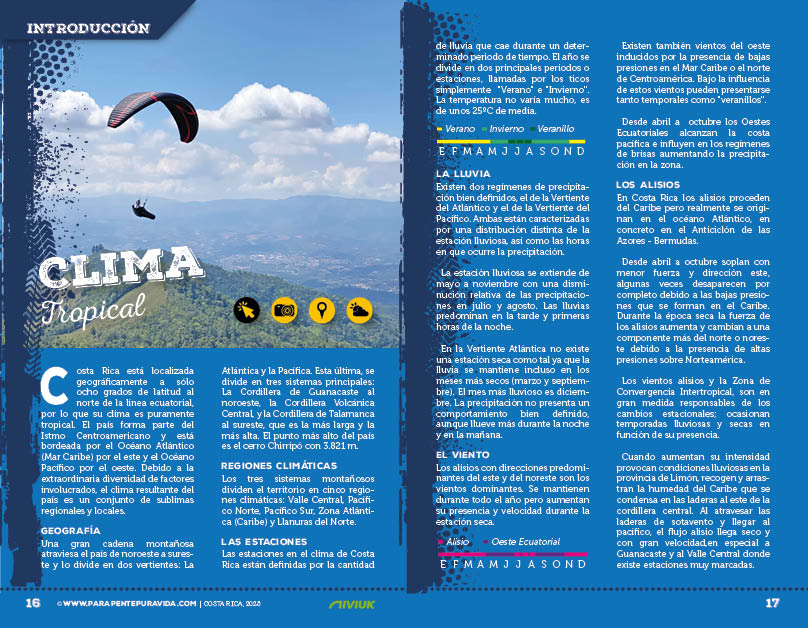
Dry season (December to April). Clear skies, stronger trade winds, and very stable weather are expected along the Central Pacific coast. It's peak tourist season and also the most consistent time for all our activities: paratriking, paragliding, skydiving, and gyrocopter flights. Virtually every day is flyable.
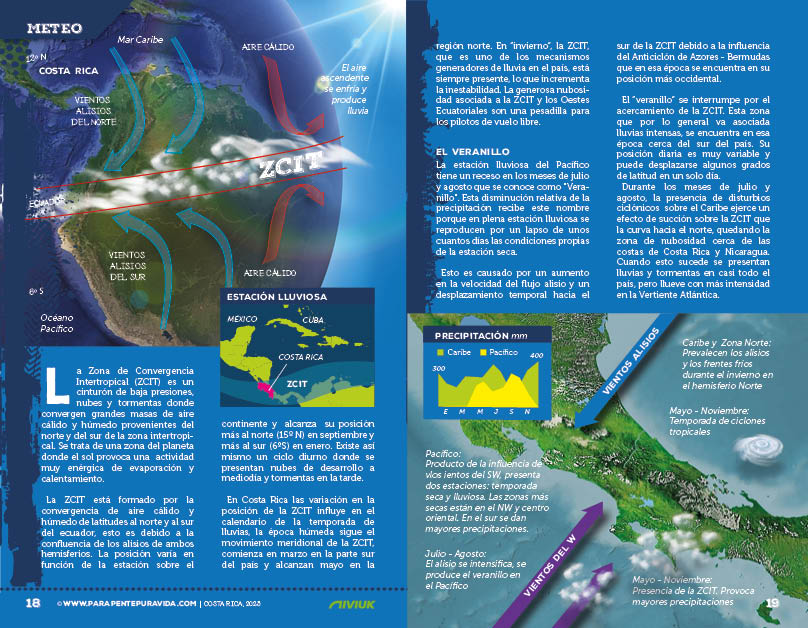
Green season (May to November).
It's raining, yes — but not all day. The typical Central Pacific pattern is textbook: It dawns clear, the morning is stable, cloud cover increases towards midday and rain arrives in the afternoon. That's why during peak season we concentrate flights in the early hours of the day. September and October are the rainiest months; even so, early morning flight windows exist almost daily.
How the wind works on the coast
The engine of flight in the Central Pacific is the sea-land thermal breeze, a cycle that repeats itself almost every day:
Each area has its own nuances—that's why we maintain specific weather pages for Esterillos, Jaco, Dominical, Quepos, Aranjuez y Turrialba, among others— but the breeze cycle is the common skeleton of the entire coast.
The special case of Turrialba. Our only indoor flying site operates on a different principle: valley thermals and mountain winds, with a typical flying window around midday and early afternoon. It's the best indoor flying site in the country precisely because the Turrialba Valley creates orderly conditions in front of the volcano.
Conditions of each activity
Not all our activities operate under the same weather conditions. Here's what we check before confirming each tour:
| Activity | Ideal wind | Typical time window | What cancels the flight |
|---|---|---|---|
| Paratrike Esterillos · Aranjuez · Manuel Antonio |
Calm or gentle breeze | Dawn and late afternoon | Strong or gusty winds, rain |
| Unpowered paragliding Jacó · Sunday · Turrialba |
Constant slope breeze | Mid-morning to mid-afternoon | Excessive or non-existent wind, cloud overdevelopment |
| Skydiving Quepos · Aranjuez |
Stable air | Early morning | Low cloud ceiling, strong winds at higher altitudes |
| Gyrocopter Cobano |
Stable air | Tomorrow | Turbulence, rain |
Here's the explanation for something that surprises many customers: The paratrike has a guaranteed flight time of 100 %, and the motorless paraglider does not. The paratrike is motorized: it takes off from the beach independently of the wind and flies for the contracted time. The unpowered paraglider depends on the slope conditions that day; therefore, flight times are approximate. It's not a difference in quality, it's a physical one.
How do we read the report?
Every afternoon we review the same sources that we openly publish in The Weather:
- The IMN's regional forecast (National Meteorological Institute), published daily at 5 pm. It is the basis for reconfirming the tours for the following day.
- The IMN's automatic stations closest to each flight zone: real wind data and not just a model.
- NOAA/GOES Satellite: The visible and infrared image tells us how cloud cover evolves over the Pacific in real time, which is especially critical during the growing season.
- Tide tables (Surfline): In Esterillos we take off from the beach; the tide determines how much beach is available and at what time.
- Live webcams In several of our areas: nothing replaces seeing the real sky of the site.
The combined reading is what makes the decision. A model might predict a good day, but the satellite might show a line of cloud cover moving in from the sea: the satellite wins.
Why do we reconfirm 24 hours?
Our protocol is always the same, and it's deliberate:
- Reservations without prepayment (except skydiving, which requires a deposit).
- The day before the tour, after the IMN report at 5 pm, we will contact you to reconfirm. appointment, place and time.
- If the forecast is not good: We cancel, reschedule, or offer you an alternative activity or area. With seven flight zones and five activities, there's almost always a real plan B.
Why so much insistence? Because the alternative—making you drive two hours only to discover on the beach that there are no flights—costs you time and money, and flying "because the client is already here" under dubious conditions is not part of our way of working. Safety is the reason this guide exists. A pilot who has been flying for 25 years is not the one who never cancels: he is the one who knows when to do it.
Frequently Asked Questions
Ready to fly?
Check the weather in your area at The Weather and write to us to check availability.
Reservations without prepayment.