Dominic Rohner – Swiss XC Rider in Costa Rica (III)
Dominic Rohner is an instructor, guide, and member of the Swiss Paragliding Cross-Country League team. Last October, he broke his personal record of 538km in Brazil. Dominic recently visited Costa Rica and completed over 330km of cross-country flying in just four flights in the Rivas, Dominical, and Santa Elena areas of Guanacaste.
We have a very long interview (to be published in 3 chapters) in which he shares some tips for covering more than 500 km in a paraglider, his experience and motivation in flight, his impressions of Costa Rica's conditions for cross-country paragliding. And of course, a detailed explanation of his 90 km cross-country flight in Guanacaste.

You recently visited Costa Rica to indulge in your two great passions, kitesurfing and paragliding. From your experience as a Swiss "mountain" pilot accustomed to the thermals of the Alps, how do you feel flying in a tropical environment: small, narrow thermals without well-defined cores, relatively low ceilings, and high humidity?
Well, yes, comparing the conditions in Costa Rica with those in the Alps is quite different. A good day in the Alps is incredibly strong. The thermals are very aggressive and well-defined, but I enjoy all types of flying, and I'm quite familiar with the tropics. I've flown a lot in Brazil and Colombia, and I love it there; I'm fascinated by the tropical environment.
You don't get large drops between thermals like in the Alps; in the transitions there aren't as many dips, everything is more floaty. You fly with a lot of clouds and usually very close to them; there are many birds, many vultures, and you often fly quite close to the ground, so you can observe what the country is like. I've gotten quite used to these kinds of conditions. And well, it's very interesting; I like it a lot.
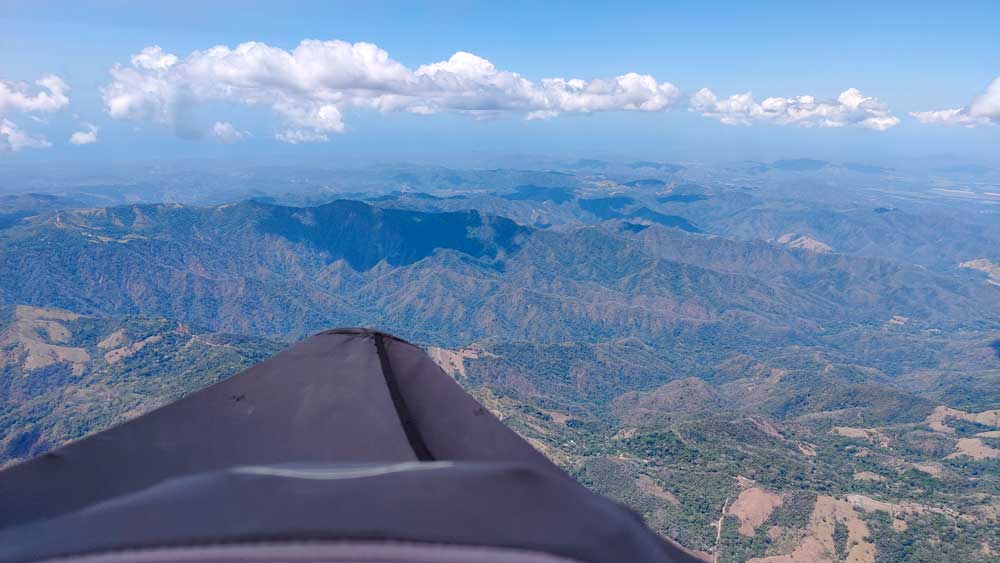
I took a short flight from Dominical to Parrita. Leaving the coast, the ceiling was 600 meters, not very high, but beautiful. For me, flying above palm trees, rivers, and forests, always so close, is fantastic. From the sky, yes, but so close that you really enjoy it. I love this game, although it's a very fast game, that's for sure. You're usually gliding for a short time and you always have to be turning, searching, and searching. Also, the cycles are quite short, but I love this type of flying. More than flying, it feels like you're playing; it doesn't seem so serious.
Flying cross-country in Dominical is fantastic; the conditions are great. They're not super strong or turbulent. But wow, there aren't many landing spots! Haha! That can be a little stressful.
You flew in the "heart" of Costa Rican cross-country flying, the El General Valley and Rivas. It's undoubtedly our best place for cross-country flying in the country. On the 7th, you completed a fantastic triangle over the El General Valley, taking off from Rivas and covering a distance of 100 km, and it was your first time flying there. Congratulations! Describe your flight for us. Did you fly first north, then southeast towards Buenos Aires, and return via San Pedro? What did you like most about your flight? And what did you like least?
Yes, it was a really beautiful day in Rivas. We took off from Alex's Launch, and the ceiling wasn't super high at first, so we went a little to the north. Initially, it was a bit technical because of the lack of altitude in those small valleys. There aren't that many landing spots there either. But the day kept getting better and better. I was flying with Zion and William; we flew together. I did the whole flight with William. Unfortunately, Zion's throttle broke after we'd only been flying for about half an hour, and he had to land because without the throttle, he couldn't keep up with us.
It was beautiful, I loved the views. There's so much rainforest, and flying over it is absolutely stunning. On the way back from Buenos Aires, we encountered some overdeveloped areas that had grown considerably. There were a lot of clouds over the valley, and also some very shady areas. But it was really interesting being there, playing with the clouds and looking for the remaining sunny patches over the El General Valley. And then, on the way back to Rivas, the day turned into a huge one. At the Los Indios launch site, I caught a +5 m/s thermal, a really strong one. And from up there, I saw the whole valley; it was perfect, literally perfect.
Rivas is protected from the trade winds by the Talamanca mountain range; however, traveling through the El General valley can sometimes be difficult if the valley breeze is present, and the southern venturi is a challenging point to navigate. What are your thoughts based on your experience?
I think Rivas has much, much more potential to do more than the 100 kilometers I did. The local pilots told me that after Buenos Aires, it gets a bit complicated with the winds, due to the presence of the venturi there. And well, I don't know, it's always good to talk to the locals, to the other pilots. I don't know that much.
I think Zion and William flew the longest triangle, I believe 144 kilometers, from Tinamasté to Palmar Norte and back to Dominical. They went north to a small town—I don't know its name—and returned. Zion has many track logs of long flights. I think this valley is fantastic; it has many, many possibilities.


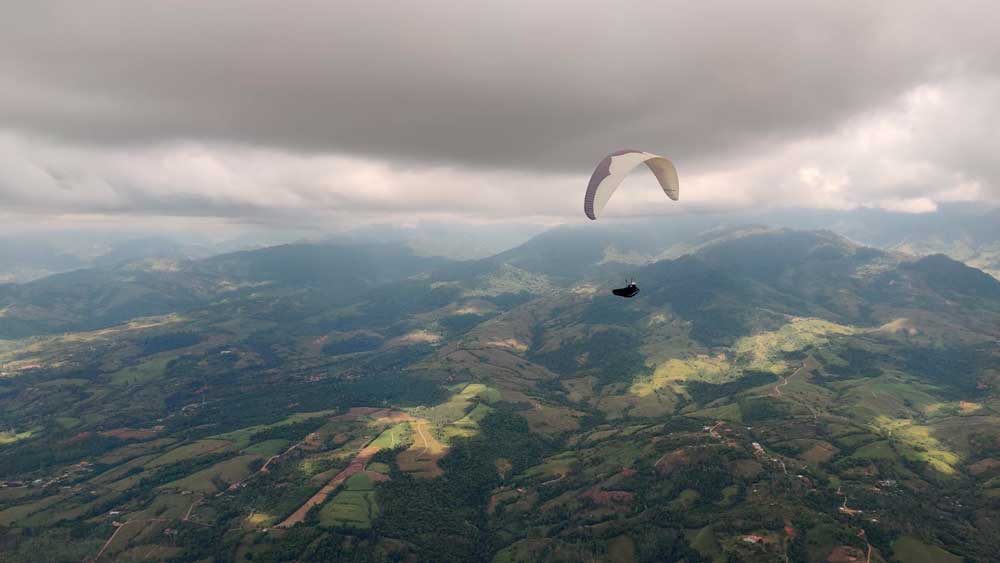
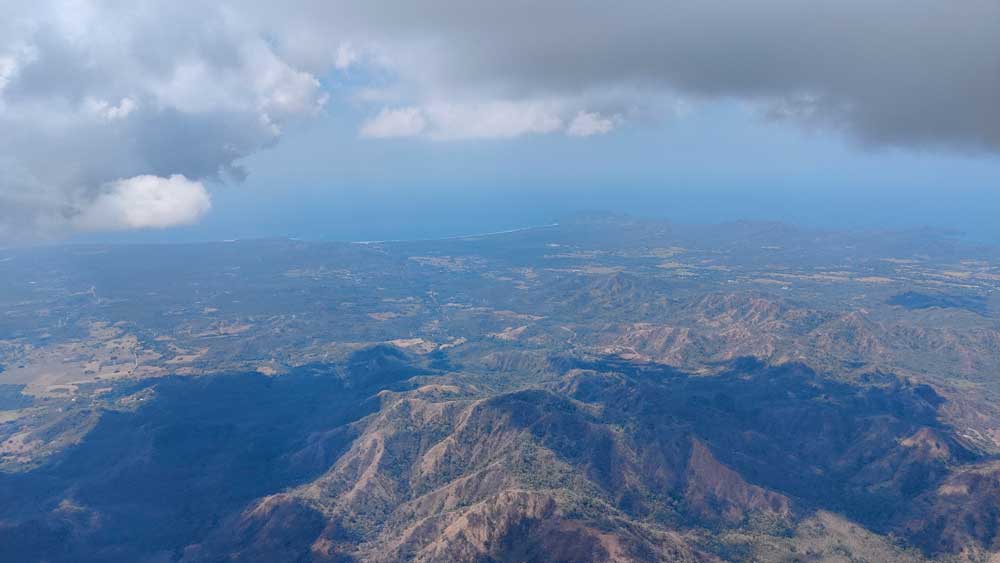
Finally, congratulations again! You've left all the pilots in Costa Rica speechless. I'm referring to your flight over Guanacaste in February! This has opened the eyes of many pilots in this country. It's possible to fly long distances in Guanacaste, and you've proven it! Another incredible triangle! Almost 90 km taking off from Santa Elena. How did you prepare for this flight? Normally—this year is different due to the La Niña effect—the trade winds make this part of the country unsuitable for flying in February, but you saw the potential.
Well, my girlfriend bought a small plot of land in Guanacaste, so being a pilot, the first thing I thought was, "I'm going to see if I can paraglide there." There's a website called thermalkk7.com, and it's super easy to view all the track logs from pilots around the world who upload them to their database. It's like the XC Contest, Leonardo… there are many more, but ultimately it's another app with a huge collection of track logs, and the best part is that the map visualization is excellent. I'm a bit of a geek and I like to see everything on Google Maps and similar mapping apps. However, none of these apps showed many take-offs in the area. Not even on Paraglidingmap.com; I only saw a couple of take-offs there.
Somehow they didn't quite convince me, I don't know why, it was just a feeling. But on Windy.com I did find what I was looking for: 2 or 3 more in Santa Elena. I thought, "They're only Windy, but oh well, I don't care.".
I went to Google Maps to find out a little more and thought it really could be a good option, so I didn't think about it any further.
I went to Salinas Bay to kitesurf at Copal Beach and checked the forecast: a week with almost no wind in Copal and I thought, well, if there's no wind for kitesurfing here, there won't be much wind in southern Guanacaste.
And I checked Windy a bit. Other forecasts and there really was very little wind.
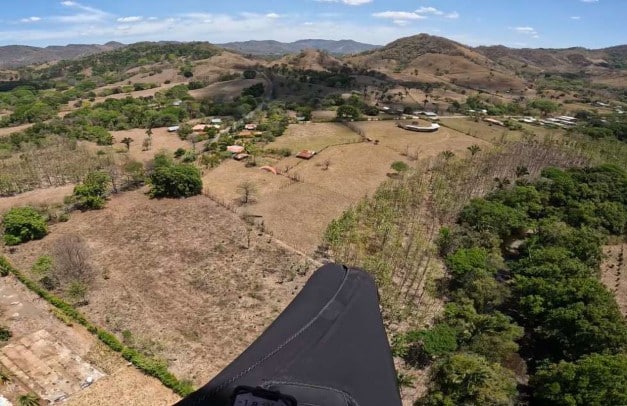
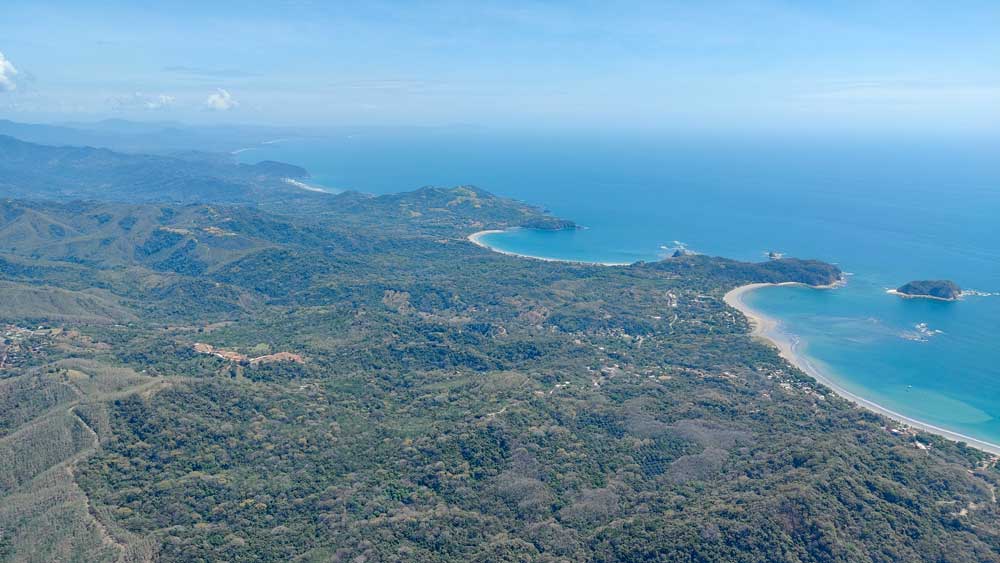
So I grabbed my things, my car, and headed to Sámara. The next day I took a taxi up to Santa Elena. And it was a really good launch site, really beautiful, the scenery was just great. There's no good landing, no way, but the launch itself is superbly done.
I saw on Google Maps that in the direction of Tambor, towards the southeast there was more vegetation than towards the north-northwest.
The area towards the National Park was very forested and also had the most challenging landings.
I wanted to go towards Tambor at the beginning, but at takeoff the birds weren't really going up, but there were clouds and the clouds were getting bigger every minute.
And finally I said to myself, “Well, I’ll go.” It was around 11:00 a.m., the sun wasn’t shining much, but the thermal was there, much stronger than I thought. “I don’t know what the birds are doing in Guanacaste, they don’t want to fly or something.” But surely if I had waited an hour or an hour and a half to take off, it would have been too late.
Towards Tambor, in a southeasterly direction, the clouds were very, very large and there was a lot of shade. So I followed the line of clouds, more or less, where I thought it would be easiest to fly given the conditions, and that led me along the route I eventually flew towards Flamingo.
On the way back I always followed the clouds and in the end I found a lot of shade, and then I decided to land, halfway between Nicoya and Sámara, after a little while I already felt the sea breeze coming in.
I remember that before landing, an hour earlier, in the Nicoya area, I was looking towards the northwest and I said to myself: “I think I’m going to start to understand the winds and conditions in Guanacaste,” because in front of my eyes there was a textbook convergence.
The point is to understand how the winds interact: the sea breeze on one hand and the prevailing east-northeast wind (trade wind) on the other in that region. This will always create a convergence if conditions are calm. I think it has great potential. Wow, I don't know, but there's a lot of potential in Guanacaste.
What do you think the flying conditions are like in Guanacaste? Tell us about your trip through the flatlands on the second day!
I'm not familiar with the typical weather conditions in this area, but it seems to me that in Guanacaste you have to take advantage of the opportunities when they arise. And during those windows of good weather, I think the possibilities are vast.
On the second day, I also took off from Santa Elena. There was a bit more wind from the northeast, and I got tired of battling it. But it was still super beautiful; the ceiling was 2,000 meters. I flew back to Sámara beach and landed on the sand, very close to my hotel. It was a beautiful and very scenic flight.
I have to thank Harry Knight for his help. We chatted a bit on WhatsApp and he told me he was a novice pilot, but thanks to him and his friend Villar I saw those takeoffs on Windy.com and without them I don't think I would have taken off there. So thank you very much!
What do you think you've learned from your experience flying in the tropics and in Costa Rica? What conditions have you encountered for paragliding in Costa Rica, besides the many cables and few places to land?.
 –
–
Well, I've been flying in the tropics for many years now, this type of flying is not new to me: lots of humidity, lots of clouds and low ceilings.
I really enjoy flying this way, and I believe you learn more. All pilots should fly in all kinds of conditions if possible. If you have the opportunity, it's good to fly in strong or weak thermals; in humid or dry conditions; with high or low ceilings; with wind or without. Practicing dynamics, thermals, ridge soaring—basically everything. To be a well-rounded pilot, you have to train in any situation and try to resolve any in-flight incident.
And why am I telling you this? I know many pilots who think, "Today is a bad day, oh well, tomorrow will be better." They're just waiting for the perfect day, that's all.
Some pilots only fly on good days, and I think that's a mistake. You also have to fly on challenging days, with weak thermals and strong winds; that's how you improve. You have to learn to fly in all conditions.
Although it is true that landings in Costa Rica are, well, somewhat "special", and that would be a point that could be improved ha, ha, ha..


DOMINIC OFFERS EMPLOYMENT FOR 2022

Dominic is looking for someone to help him with his group of pilots for 2 weeks in February or March 2022
The person must be:
- Responsible
– Good driver
– He likes working with people
– (pilot)
What the job includes:
– Pick up pilots at the airport and drive them between flight sites
– Pick up riders who left the motocross track
– Solve small daily problems
- etc
What does the job offer?
– Hotel, food, other expenses paid
– A salary to be defined
– Two weeks at different flight sites in CR (Caldera, Jaco, Parrita, Dominical, Rivas…)
– Since we're going to be doing a week of cross-country flying in Rivas, we'll be discussing many aspects of free flight in the briefings before and after the flights. A pilot can certainly benefit greatly from these discussions and from spending two weeks in a group of only pilots.