Paramotor propellers and sizes - Paragliding Pura Vida
I'd like to explain why a large propeller is better than a small one. In fact, I'm going to cover everything about the different types and designs of propellers. Several parameters need to be considered when designing a new propeller: 1. Diameter 2. Airfoil 3. Chord 4. Angle of attack 5. Number of blades. These five parameters must be balanced. If you have a propeller that works well with a specific motor and you want to improve it, simply changing one thing won't be enough. You can't just increase, say, the propeller diameter and leave everything else the same because the propeller will create more resistance for the motor, and it won't have enough power to reach the desired RPM.
Diameter and thrust
Speed is the enemy of anything that flies because the greater the speed, the greater the drag. Air behaves the same way around a propeller. If you try to move air very fast, vortices and drag will occur at the edges of the airflow. This means it's more efficient to try to move a large volume of air at a lower speed than a small volume at a higher speed.
This means that a propeller with a large diameter moves a large mass of air at a lower speed. A smaller propeller only captures a small amount of air, and to achieve the same thrust, the air needs to be moved faster, which is inefficient.
In paramotoring, a 125cm propeller is more or less the norm. At Scout Paramotors, we use a 132cm propeller. Why? Because with a relatively small increase in diameter, you get significantly more thrust.
How much more? Well, if you eliminate the tip and center areas, which don't contribute to the thrust, the difference in the effective thrust zone
The difference between a 125cm propeller and a 132cm propeller increases to 16%, even though the diameter difference is only 6%.
This doesn't mean a larger propeller is 16% more efficient, but it's close. What it means is that the larger propeller captures 16% of air volume with each rotation, so it moves a greater volume of air, which is sufficient to move it at a lower speed.
How to choose the size
So, what size propeller do you need? I'd say buy the biggest one you can. Of course, if you already have a paramotor, you'll be limited in your options, but you need a 7cm clearance on each side between the propeller tips and the cage as a safety margin.
If you have the option of choosing a larger cage, do so, as long as you can fully extend your arms to take off properly.
However, it cannot be too large. An important factor is the reduction ratio, which determines the propeller's rotational speed.
Let's take three examples: a conventional 125cm propeller; a 132cm propeller and an extreme 150cm propeller; all with the same 185cc Vittorazi Monster Plus engine.
With a reduction ratio of 2.68 and a maximum RPM of 8,600, you'll barely get 3,200 RPM.
With a 125cm propeller, the tips will rotate at a speed of Mach 0.62 (about 765km/h). With a 132cm propeller, the speed is 0.65. With a 150cm propeller, the speed would be above Mach 0.7.
The ideal speed for a propeller is Mach 0.62. If the tip speed is increased beyond this point, the noise becomes unbearable.
That's why our 132cm Scout propeller failed the sound test in Germany, which was required for certification. It was slightly louder than the permitted limit.
With a 150cm propeller, it is necessary to change the reduction ratio in the motor to keep the revolutions low.
Propeller profile
The next thing to consider is the profile. Each manufacturer and each designer chooses different profiles.
If we compare three common types, the popular Helix (helix-propeller.de) has a rather stocky profile; then there is the 132cm Scout (scoutparamotor.com), similar to the Helix but more streamlined; and finally, the e-Prop (e-props.fr) has a slim profile.
In a profile, what matters is not the thickness but the shape. The relatively streamlined profile of the e-prop is made possible by a very interesting production technology that allows them to be made so thin.
The other difference is also the smaller surface area of the propeller. On the Scout propeller, it's a straight line. e-Prop was the first to put a curve in the lower airfoil.
In the end, they are three different ways to achieve basically the same thing.
Pitch and angle of attack
The last thing to consider is the pitch. The pitch of a propeller is the distance the propeller travels in one revolution as if it were perfectly cutting through the air. The pitch is determined using the chord and the angle of attack of the propeller.
At Scout, we've been working on a new propeller and have made some decisions. We decided to use a larger diameter propeller, 132cm, which is the largest that can be safely used on the Scout chassis, and we chose a new airfoil, inspired in some ways by the e-Prop. The last thing to do is set the propeller's angle of attack.
No matter how much you work on the computer, you'll never know what angle of attack to use until you fly the paramotor. We used adjustable propellers in testing so we could change the angle of attack and find the sweet spot.
Increasing the propeller's angle of attack increases the pitch, placing more load on the engine. Therefore, if the angle of attack is too high, the engine will not have enough power to reach the desired 8,600 RPM.
If the angle of attack is too flat, the propeller will not be efficient and the engine will rev above 8,600 RPM and cause damage.
Therefore, it is important to find the optimal point to properly charge the engine.
Once manufacturers have found that sweet spot through testing, the final step is to create a fixed-pitch propeller that is convenient and easy for the consumer to use.
- CLEARANCE BETWEEN PROPELLERS Regardless of the propeller you use, for safety there should always be 7cm between the tips and the cage. Photo: Scout Paramotors
static thrust test
So, how do you know which propeller is better than another, or which one is best for you and your engine? The general rule is that bigger is better: you get more thrust and efficiency with a larger propeller.
Similarly, if you have three propellers of the same size, how do you know which one is best? The most common way to find out is with a static test, which involves testing a paramotor on a test bench and measuring the static thrust.
But the truth is, you don't get reliable data; you can only compare data measured on the same day with the same engine and the same humidity and air pressure. Measurements taken on two different days are not comparable.
Is it useful? At Scout we don't do static propeller tests because I find it pointless.
Real-world tests
There are better ways to compare propellers. When I test them, the first thing I want to compare is the rate of climb, which is very easy to measure. You just need to take off on the same day, with the same wing, the same weight and pilot, release the brakes so as not to interfere with the piloting, and measure how many seconds it takes to climb 100 meters.
That's the most accurate measure of dynamic thrust you'll get. You won't get the thrust figure in kilograms, but you will get the rate of climb so you can compare which propeller produces more thrust on the same day and under the same conditions.
The second crucial thing to test is the cylinder head temperature after a 30-second climb at full power. The Vittorazi Monster Plus is somewhat sensitive to high temperatures, which is why most propellers have cooling fins and why a good engine cooling system is so important.
The fourth aspect is the RPM required for straight flight, as this will determine fuel consumption on cross-country flights. Lower is better. It's a good idea to check the cylinder head temperature during straight flight, but it's generally not a problem.
The three propellers I mentioned, Helix, e-Prop and Scout, are the same in terms of climb rate, cooling at maximum power, RPM at cruise speed and temperature at cruise speed, and I didn't notice much difference.
One thing you'll notice is a difference in sound. Noise, measured in decibels, plays an important role in Germany and Austria, countries where this measurement is part of the homologation process.
Our Scout engine failed the homologation because it was slightly over the limit, perhaps because the propeller is a bit larger, which makes the tip speed faster and the sound louder.
Another thing I've noticed is a difference in altitude performance. When I flew in the Icarus Trophy in the United States, we did several high-altitude flights over mountain ranges. I felt that the e-Prop had a little bit more performance at altitude. It's not something I could measure; I didn't have the equipment, but that's how it felt.
Finally, there is acceleration, determined by the weight of the propeller. The more mass needed to accelerate, the more energy is required, and the longer it takes the propeller to reach maximum RPM.
In this respect, the e-Prop is the lightest. This isn't a problem if your flying style involves cruising at speed and covering distance; it's only something to consider if you use a lot of sudden power, such as in slalom flying. In that case, a lighter propeller would be better.
FRESH CARBON In airfoils, not only thickness matters, but also shape. The new Scout Paramotors propeller is inspired by the e-Prop airfoil, which has a curved lower surface. Photo: Scout Paramotors
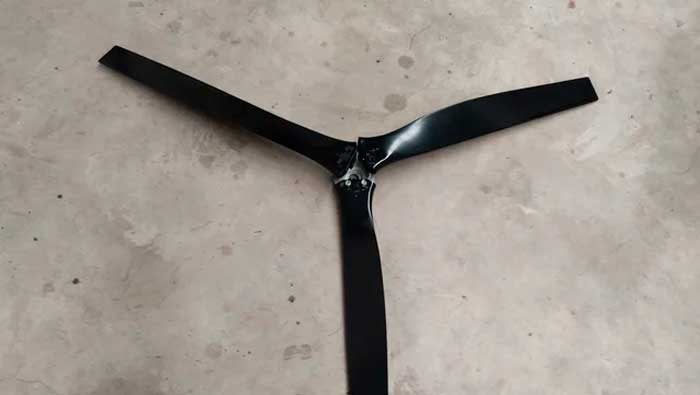
Three-bladed propellers
I tried a few three-blade propellers and concluded that I didn't gain any thrust. However, there was less vibration, and the sound was excellent!
The sound of a three-bladed propeller is different. I thought it was louder, but that wasn't the case when we measured it. But the tone is impressive, like a MotoGP propeller.
The disadvantage is that they are obviously more expensive and heavier than two-bladed propellers.
However, if you're flying a very powerful engine, like a Polini 250, you need a lot of moving air to get that much power to the propeller. A larger propeller is best, but your wingspan is the limiting factor. Other options include using wider blades with a longer chord, using more blades, or increasing the angle of attack.
For a powerful engine, a four-bladed propeller is a good option.